More Green on Europe’s Buildings: How New EU Legislation is Transforming Cities

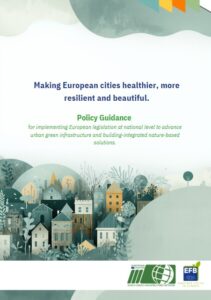
The new Policy Guidance from EFB and WGIN outlines concrete steps.

Free access!

Europe is at a turning point: cities must become more resilient, healthier, and climate‑friendly. With four key legislative acts – the Energy Performance of Buildings Directive (EPBD), the Energy Efficiency Directive (EED), the Urban Wastewater Treatment Directive (UWWTD) and the new Nature Restoration Regulation (NRR) – the European Union is, for the first time, establishing a binding framework that positions green infrastructure not only as a recommendation but as a strategic instrument. Building greening thus becomes a political lever that extends far beyond aesthetics: it is intended to save energy, manage water, mitigate heat, promote biodiversity, and make Europe’s cities fit for the future.

A political paradigm shift

For a long time, urban greening was a voluntary extra. Now it has become part of a binding transformation pathway rooted in the European Green Deal, the Kunming‑Montreal Global Biodiversity Framework, and the New European Bauhaus Initiative. The EU recognizes that green roofs, façades, and blue‑green systems are indispensable for strengthening urban resilience and reducing health risks caused by heat and extreme weather.

Europe has set the political framework – now national implementation must begin. Green roofs and green façades will become key elements for making cities climate‑resilient, liveable, and healthy. The new EU laws offer not only political pressure but also a historic opportunity: the systematic integration of nature into the built environment.

Why greening is so effective

All four EU laws point to a shared challenge: cities are overheating, losing water, suffering from air pollution, and facing declines in biodiversity. Green infrastructure addresses all of these issues simultaneously. Studies compiled by the EFB in 2025 show:

  • Energy: Green roofs and façades reduce heat gains in summer, lower cooling demand, and improve winter insulation.
  • Water: Advanced Retention roofs can locally retain up to 100% of rainfall.
  • Biodiversity: Species‑rich green roofs and façades support wild bees, beetles, birds, and diverse plant species.
  • Urban climate: Vegetation cools surfaces, reduces heat islands, and improves outdoor comfort.

Discover the legislative pathways here:

EED: Saving energy through vegetation

The public sector must reduce its annual energy consumption by 1.9% starting in 2025. Additionally, the Member States’ energy‑saving obligations will rise significantly from 2024 onwards. Green roofs and green façades are among the most effective, durable, and verifiable measures: they reduce summer overheating, improve winter insulation, reduce the burden on heating and cooling systems, and provide benefits over decades. Depending on climate zone, studies show winter energy savings of 10–30% and up to 90% in summer.

EPBD: Solar obligations and building renovation as an opportunity for green roofs

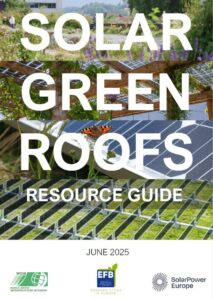
The revised Energy Performance of Buildings Directive requires Member States to gradually install solar energy systems on almost all building types – starting in 2026 with new public non‑residential buildings and from 2030 onwards also on existing buildings over 250 m² of usable floor area. Crucially, the directive explicitly demands an assessment of whether roofs are suitable for combining photovoltaics with vegetation. Such biosolar roofs improve PV performance, cool modules and roof surfaces, extend system lifetimes, and create valuable habitats.

The EPBD also sets strong impulses in the building stock: by 2030, the 16% worst‑performing non‑residential buildings must be renovated, rising to 26% by 2033. For residential buildings, primary energy consumption must drop by 16% by 2030 and 20–22% by 2035. Green roofs and façades are recognised as effective measures to reduce heating and cooling demand.

UWWTD: Retaining water instead of
overloading systems

The new EU Urban Wastewater Treatment
Directive revolutionizes the way cities manage rainwater. From 2028 onwards,
Member States must identify which cities require integrated rainwater
management plans due to overflow events, pollution, or climate‑related risks.
These plans must prioritise green and blue infrastructure – systems that store,
delay, evaporate, or locally reuse rainwater. Green roofs, retention roofs,
rain gardens and green façades thus become binding planning instruments that
help prevent flooding and significantly reduce pressure and costs in sewer
systems.


NRR: No net loss of urban green space from 2030

The new Nature Restoration Regulation introduces binding targets for urban ecosystems. From 2030 onwards, Member States may not allow any net loss of urban green space; from 2031 onwards, the total area of urban green must increase. Innovative and important: building greening is explicitly recognised as a means to achieve these targets. Green roofs and façades close spatial gaps, connect habitats, and create stepping‑stone environments for pollinators.